AI SEO Content Writing: A Step-by-Step Guide
AI SEO content writing works when you control the workflow, not when you ask a chatbot to “write a blog post.” That is the real difference between content that ranks and content that dies on page three.
Most teams do the same bad move. They open ChatGPT, type a vague prompt, get a generic draft, and conclude that AI writes weak SEO content. That is the wrong diagnosis. The problem is usually not the model. It is the lack of search intent, structure, examples, and editorial control. Your original article makes that point well.
This guide shows how to use artificial intelligence tools to build SEO content that is clearer, faster to produce, and more useful for both classic search and AI-powered search experiences. Google’s public guidance is also clear on the core principle: it evaluates content based on quality and usefulness, not simply on whether AI helped produce it. However, publishing scaled, low-value AI pages can violate spam policies.
What is AI SEO content writing?
AI SEO content writing is the process of using large language models and automation tools to research, outline, draft, optimize, and edit content for search visibility and user value.
In practice, that means using tools such as ChatGPT, Claude, Gemini, or workflow platforms to speed up production, while a human still controls the brief, fact-checks the claims, and shapes the final point of view. That hybrid model is the only one worth defending. Pure AI publishing at scale is lazy and risky. Pure manual production is often too slow. A hybrid workflow is usually the strongest option.
Why AI SEO content writing works
AI helps SEO when it removes repetitive work and gives your team a more disciplined process.
It is useful for clustering keywords, turning raw research into outlines, creating first drafts, generating metadata, and spotting repetition during editing. HubSpot’s current guidance on AI SEO tools emphasizes practical use cases such as research support, workflow acceleration, and optimization assistance, not blind one-click publishing. Zapier frames AI SEO automation in a similar way: connect your data sources, generate structured copy and metadata, then push assets into publishing workflows.
That distinction matters. If AI is doing the heavy lifting on formatting and drafting, your team can spend more time on the only parts that actually create durable advantage: strategy, expertise, and editorial judgment.

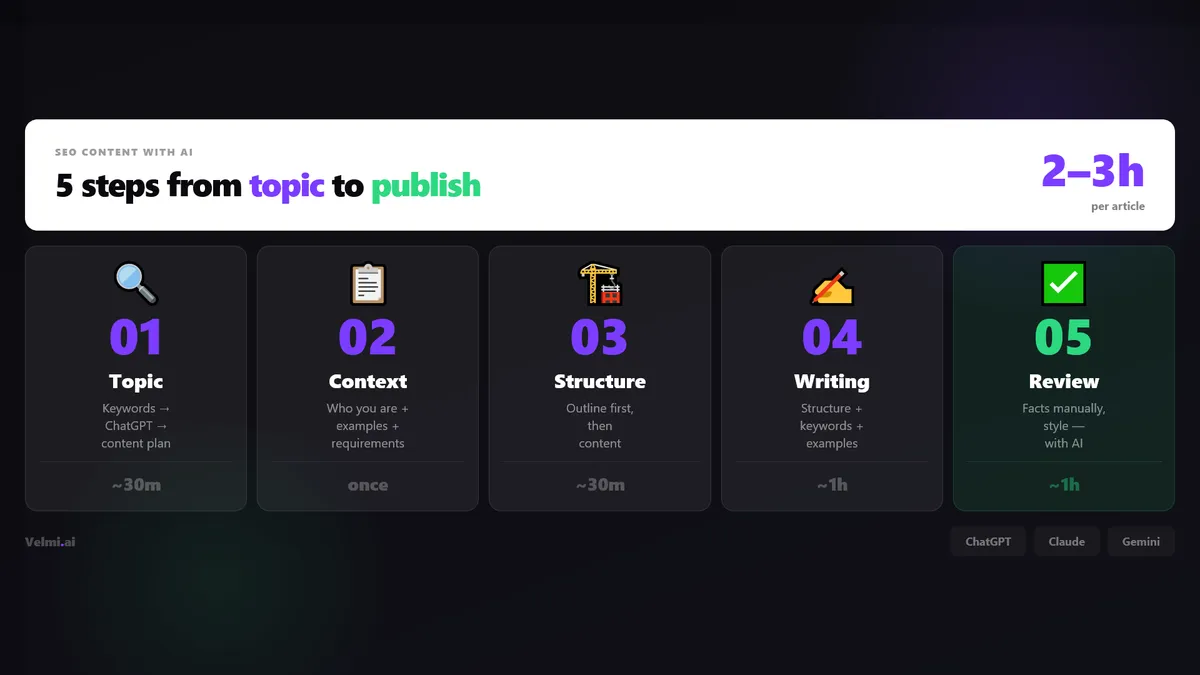
Step 1. Start with search demand, not content ideas
The first step is simple: find what people already search for.
This is where many articles go off the rails. Teams write about what sounds smart internally, then wonder why the page gets no traffic. A topic such as “innovative approaches to automation” may sound impressive in a meeting, but it is weak if nobody searches for it. A phrase like “how to automate Excel reports” has obvious demand, clear intent, and a much better chance of ranking.
For English-language markets, use tools that reflect global or US search behavior:
Google Keyword Planner
Ahrefs
Semrush
Moz Keyword Explorer
AlsoAsked
These tools help you identify search demand, related questions, keyword variations, and competitor gaps. HubSpot’s SEO tooling coverage also highlights workflow value in tools that combine topic discovery with optimization support. (blog.hubspot.com)
Prompt for topic clustering
Here is a list of search queries for [your niche]:

[paste the keyword list]

Group them by search intent and topic. For each group, suggest 3–5 article ideas.

Rules:
- Each topic must answer a clear user problem
- Avoid generic titles like “complete guide” unless the topic truly requires it
- Show the practical outcome or business benefit in the title
- Flag whether the intent is informational, commercial, or comparison-based
This gives you a content plan based on actual demand instead of internal guesswork.
Step 2. Give the model context before you ask it to write
AI without context writes generic sludge.
Before you generate anything, define three things: who your company is, who the article is for, and what the brand voice should sound like. Your source article gets this exactly right: without company context, audience detail, and style constraints, the model defaults to bland general-market writing.
What context to include
What your company does
Who the audience is
What problems they are trying to solve
What tone you want
What phrases or habits to avoid
What strong examples already exist
If your team works inside a shared content system, keep this information in one place. A centralized workspace, whether in Notion, a CMS, or an internal knowledge base, makes prompts more consistent and reduces revision cycles. Zapier and other automation platforms can also connect documents, spreadsheets, and AI tools so the same brand context is reused across drafts and metadata tasks. (zapier.com)
Prompt for context loading
You will help write articles for [company name].

About the company:
[2–4 sentences]

Target audience:
[who they are, what they care about, what they struggle with]

Writing style:
- Clear and practical
- Professional but conversational
- Short paragraphs
- No empty hype

Avoid:
- Generic filler
- Long intros
- Rhetorical questions
- Repetitive bullet points
- Claims without evidence

Here are examples of content that match our tone:
[paste examples or links]

Confirm that you understand the brand, audience, and tone before we proceed.
Step 3. Build the structure first
The outline matters more than the first draft.
This is where weak AI content usually fails. If you ask for a full article too early, the model commits to the wrong angle and wastes 2,000 words. A separate outline step fixes that. It also helps you distribute entities, questions, and supporting terms across the page in a way that is much more useful for both traditional SEO and AI retrieval.
Prompt for an SEO outline
Create an outline for an article on: [topic]

Inputs:
- Primary keyword: [keyword]
- Secondary keywords: [list]
- Audience: [description]
- Search intent: [informational/commercial/comparison]
- Target length: [word count]

Output:
1. H1 with the main keyword
2. 5–7 H2 sections
3. Key points for each section
4. H3 subheads where useful
5. A short intro angle
6. A FAQ section with 5 specific questions
7. Suggested internal link opportunities
Review the outline manually. Cut weak sections. Combine overlaps. Add sections that reflect real expertise instead of generic SEO filler. That ten-minute cleanup saves a lot of garbage later.
Step 4. Draft the article with hard constraints
Once the structure is approved, drafting gets much easier.
This is the stage where AI should help with speed, not replace editorial standards. Give the model the outline, the primary keyword, supporting terms, and explicit rules for readability and tone. Your original version recommended a fixed keyword density range, but that is too rigid for modern SEO. A better rule is to use the target phrase naturally and cover the topic comprehensively. Google’s ranking systems focus on relevance, meaning, and quality rather than formulaic repetition. (Гугл)
Prompt for drafting
Write a search-optimized article based on this outline:

[paste outline]

Requirements:
- Use the primary keyword naturally in the H1, intro, and key sections
- Use related terms where relevant, without forcing them
- Keep paragraphs short
- Keep sentences clear and direct
- Avoid filler, vague claims, and obvious AI phrasing
- Use examples where useful
- Add a practical CTA at the end
- Write in US English

Do not invent statistics, study names, product features, or pricing.
If a claim needs evidence, flag it for verification.
That last line is critical. If you do not tell the model to avoid invented specifics, it will happily make them up.
Step 5. Edit the draft like a human, not like a prompt machine
Editing is not optional.
Google explicitly warns that using generative AI to produce many pages without adding value can fall under spam policy issues. That means raw AI drafts are not a shortcut. They are a starting point. (Google for Developers)
What you should verify manually
Statistics
Product features
Pricing
Brand claims
Industry references
Quotes and study names
What AI can help clean up
Repetition
Wordiness
Weak transitions
Generic phrasing
Paragraph length
Missing FAQ opportunities
Prompt for editorial cleanup
Review this article for low-value AI patterns:

[paste draft]

Find:
1. Repetition
2. Generic claims without evidence
3. Weak or vague transitions
4. Overlong paragraphs
5. Empty phrases that add no value
6. Sections that do not answer the implied question clearly

For each issue, suggest a stronger rewrite.
That is the right use of AI in editing. Let it spot patterns. Do not let it become the final judge of truth.
AI vs human vs hybrid SEO content
The strongest model for most teams is hybrid.
Aspect | Pure AI content | Pure human content | Hybrid AI + human |
|---|---|---|---|
Speed | Very fast | Slow | Fast enough |
Cost per article | Lowest upfront | Highest | More efficient |
Brand voice | Usually generic | Stronger by default | Strong when guided |
Fact accuracy | Risky without checks | Better, but still imperfect | Best when verified |
Scalability | High | Low | High with control |
SEO quality | Inconsistent | Often better in expert hands | Usually the best trade-off |
Risk | High if published raw | Lower | Lowest with governance |
The point is not that AI is bad. The point is that raw AI publishing is weak. A hybrid process gives you scale without throwing quality off a cliff.
Tools for AI SEO content writing
Use tools based on the stage of the workflow, not because they are trendy.
For keyword research and topic discovery
Google Keyword Planner
Ahrefs
Semrush
Moz Keyword Explorer
AlsoAsked
For drafting and outlining
ChatGPT
Claude
Gemini
For workflow automation
Zapier
Google Sheets
Your CMS or content hub
For editing and readability
Grammarly
Hemingway Editor
Your internal editorial checklist
HubSpot’s AI SEO coverage is useful for evaluating how these tools fit different parts of a content workflow, while Zapier is more relevant when you want to automate drafting, metadata creation, and publishing steps across apps.
Final takeaway
AI SEO content writing is not about replacing writers. It is about building a better production system.
If you start with search demand, load the right context, approve the outline, draft with constraints, and edit like a serious operator, AI can cut production time without wrecking quality. If you skip those steps, you get generic content, weak rankings, and a bigger editing mess later.
The best next move is simple: take one target keyword, build an outline first, and run the workflow from research to edit. That is where AI actually becomes useful.
Frequently Asked Questions
Is AI SEO content writing safe for Google?
What is the best AI tool for SEO content?
How long should an SEO article be?
Should I aim for a fixed keyword density?
Can I publish AI-generated content without editing?
Want to discuss an AI solution for your business?
We'll be happy to explain how LLM models can help automate your processes
Discuss ProjectOther articles
SEO in 2026: Why Traffic Is Dropping and What to Do
Google and Yandex are answering more queries directly in search, which means fewer clicks to websites. Here’s the data, what GEO optimization actually is, and what businesses should do next.

How LLM Models Are Transforming Business Automation in 2024
Exploring practical use cases of GPT-4, Claude, and other LLMs for business process automation. From sales to content generation.
ChatGPT vs Claude: Which Model to Choose for Business?
Comparing the two most popular LLM models across key parameters: quality, speed, cost, and practical use cases.