SEO in 2026: Why Traffic Is Dropping and What to Do
You did everything right. The pages are live, rankings are stable, and the SEO budget is still there. But traffic keeps slipping — and it is not always obvious why. SEO in 2026 looks very different from the model most teams still use. You can publish content, hold rankings, and still lose traffic because AI search is changing how users discover and click through to websites.
This is not just an analytics issue. Search is changing fast. More users now get their answer directly on Google, Yandex, ChatGPT, Perplexity, and other AI-driven interfaces without ever clicking through to a website. That changes the old SEO model completely.
If your business still treats search as “rank higher → get more clicks → get more leads,” you are already operating on outdated assumptions. In 2026, visibility still matters — but clicks are no longer guaranteed.
In this guide, we will break down what changed, why zero-click search matters, what GEO optimization actually means, and the three moves businesses should make now to protect traffic and demand generation.
What Changed in Search in 2026
For years, search worked in a simple way: a person typed a query, got a list of websites, and clicked one of them. SEO was built around winning that click.
That model is weakening.
Search engines are no longer just ranking pages. They are increasingly answering the question themselves. AI overviews, instant summaries, rich snippets, and assistant-style responses are reducing the need to visit the source site at all.
A user searches “best CRM for a small business,” “how to reduce churn,” or “how much does SEO cost in 2026” and gets a structured answer directly in the interface. In many cases, that answer is enough. No click happens.
This is the core shift behind falling organic traffic. The issue is no longer just ranking. The issue is whether search engines and AI systems leave any reason to click in the first place.
Why this matters for business
Stable rankings do not guarantee stable traffic anymore. A page can still hold position, yet lose visits because the click opportunity above it has been taken by AI-generated answers, enriched SERP features, and zero-click behavior.
For B2B companies, agencies, SaaS products, and service businesses, this is not a small algorithm update. It changes how content creates pipeline.
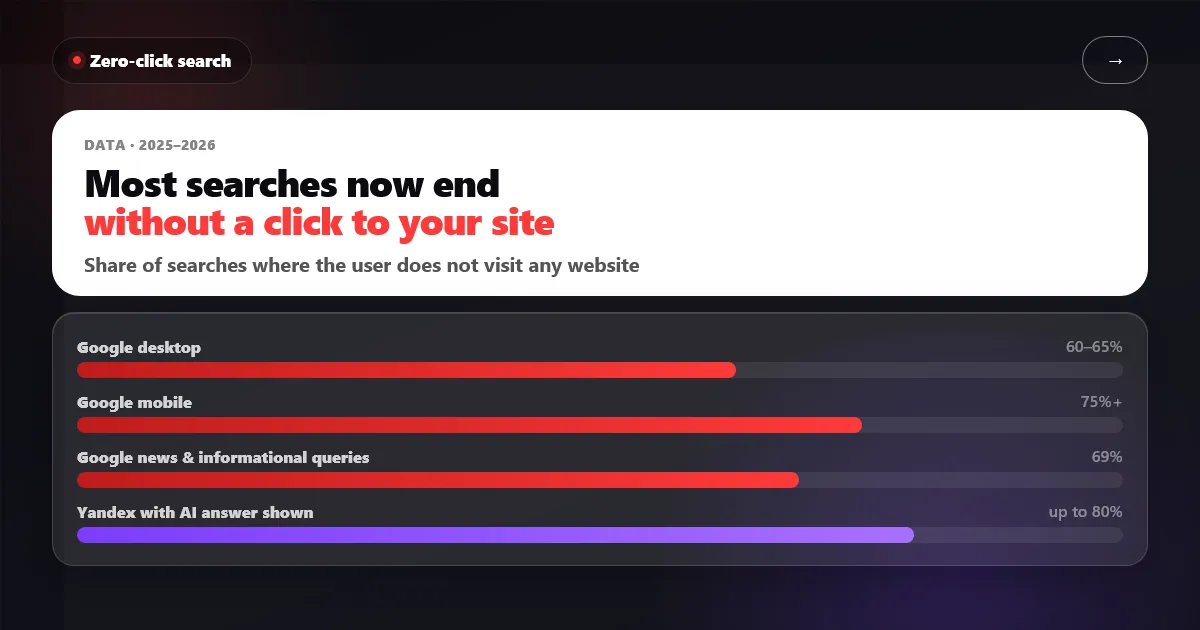
Zero-Click Search Is No Longer a Side Effect
Zero-click search used to be associated with simple queries: weather, calculators, exchange rates, definitions. That is no longer the case.
In 2026, zero-click behavior affects informational queries, comparison queries, light commercial queries, and even some bottom-funnel searches. The search engine often acts like a filter, summarizer, or recommender before the user ever reaches your site.
That creates three immediate problems:
First, your site loses traffic even when rankings do not collapse.
Second, reporting becomes misleading because visibility and clicks decouple.
Third, customer acquisition becomes more expensive because fewer search impressions turn into sessions and leads.
This is why many teams feel something is broken while their dashboards still show decent average positions. Nothing is “broken.” The click path itself has changed.
Why Traditional SEO Is Losing Efficiency
Classic SEO logic looks like this:
Rank in the top results → attract clicks → convert traffic into leads or revenue
That middle step is now weaker than it used to be.
Even strong pages can get less traffic because AI summaries sit above them and satisfy intent early. Organic positions still matter, but they matter differently. They are no longer just click drivers. They are also source signals for AI systems, trust signals for users, and brand reinforcement inside the search journey.
That means old content strategies start to underperform, especially if they rely on:
generic top-of-funnel content with no original insight,
thin SEO pages written mainly to target a keyword,
rewritten material that says the same thing as every competitor,
weak structure, weak evidence, and no clear expertise.
In other words, “publish more SEO articles” is no longer a strong enough strategy on its own.
What weak content looks like in 2026
Weak content is easy to spot:
it explains a concept without adding anything new,
it has no original examples or numbers,
it is bloated with definitions users can get instantly from AI,
it reads like it was written to fill a keyword gap, not solve a problem.
That kind of page is vulnerable from both sides: it loses clicks in search, and it is less likely to be cited by AI systems.
What GEO Optimization Actually Means
GEO stands for Generative Engine Optimization.
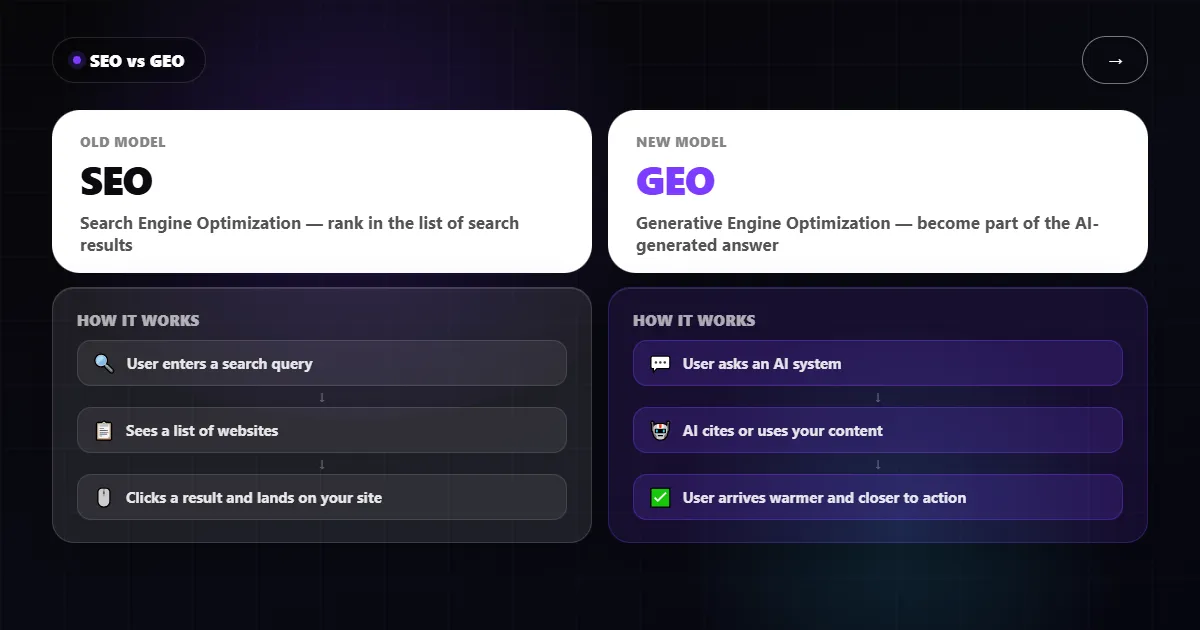
If SEO is about ranking in search engine results, GEO is about becoming a source that generative AI systems can use, summarize, cite, or recommend.
That distinction matters.
In traditional SEO, you compete for a position in a list of links. In GEO, you compete for inclusion in the answer itself.
That means your content has to do more than rank. It has to be easy for AI systems to parse, trustworthy enough to reference, and useful enough to deserve mention.
SEO vs GEO: the real difference
SEO asks:
Can this page rank for the query?
GEO asks:
Would an AI system trust this page enough to use it in an answer?
That changes how content should be written and structured.
Pages that perform better in GEO tend to include:
clear topical focus,
direct answers to specific questions,
original data, cases, or expert commentary,
strong headings and clean information architecture,
explicit definitions and comparisons,
structured markup where relevant,
visible trust signals.
If your content is vague, generic, over-optimized, or empty of real proof, it is weak for both search and AI discovery.
What Content Still Works in AI Search
A lot of businesses are reacting badly. They hear “AI search” and either panic or start publishing generic thought leadership about AI. Both are weak moves.
What works is much simpler: make content more useful, more specific, and more source-worthy.
Content formats that are stronger in 2026
Case studies with real numbers
Not fluffy success stories. Real context, actions, constraints, and outcomes.
Comparison pages with opinionated analysis
Not “tool A vs tool B” rewritten from public pricing pages. Actual expert comparison with use-case framing.
Detailed FAQ content
Not filler questions. Real objections, decision-stage concerns, implementation friction, buying criteria.
Guides with operational detail
Step-by-step content that helps users act, not just understand.
Research-backed articles
Original insight wins. Even small proprietary data points make a page more defensible.
Content formats that are weaker in 2026
dictionary-style pages,
generic “what is X” posts,
repetitive trend summaries,
templated SEO content with no expertise,
pages written for volume instead of utility.
If an AI system can generate the same answer without you, your content has no moat.
Three Practical Moves to Protect Traffic in 2026
1. Shift from keyword volume to source-worthy content
The first move is not “publish more.” It is publish less generic content.
Audit your content library and cut hard. Separate pages into three buckets:
pages that still drive business value,
pages that need rewriting,
pages that are dead weight.
Then rebuild around content that has a reason to be cited and a reason to be clicked.
What to prioritize:
customer questions with strong buying intent,
pages with original examples, cases, or frameworks,
high-intent commercial and comparison topics,
content that reflects actual expertise from your team.
The goal is not just search visibility. The goal is to become a credible source across both search and AI interfaces.
What to improve on-page
add stronger headings and clearer answer blocks
put key definitions and summaries higher on the page
add FAQ sections where decision friction exists
use schema markup where relevant
tighten weak intros and cut filler paragraphs
include proof: screenshots, numbers, examples, outcomes
2. Build owned distribution outside search
If search is becoming less reliable, depending on it alone is weak.
You need channels that let you reach people directly:
email newsletters,
LinkedIn distribution,
Telegram channels,
communities,
webinars,
partner ecosystems,
branded demand capture.
Owned channels reduce dependency on algorithms and let you reuse content more intelligently. They also support branded search, which becomes more important as generic search clicks get squeezed.
This is not just a media-company move. It matters for service firms, SaaS products, agencies, and consultants too. If search shrinks as a click channel, brand and direct audience become more valuable.
The practical angle
A strong article should not live and die on Google. It should also feed:
newsletter content,
social posts,
founder-led distribution,
sales enablement,
remarketing,
outbound proof assets.
If one article only exists to rank, it is fragile. If it also strengthens brand and sales, it becomes more resilient.
3. Put AI inside your funnel, not just outside it
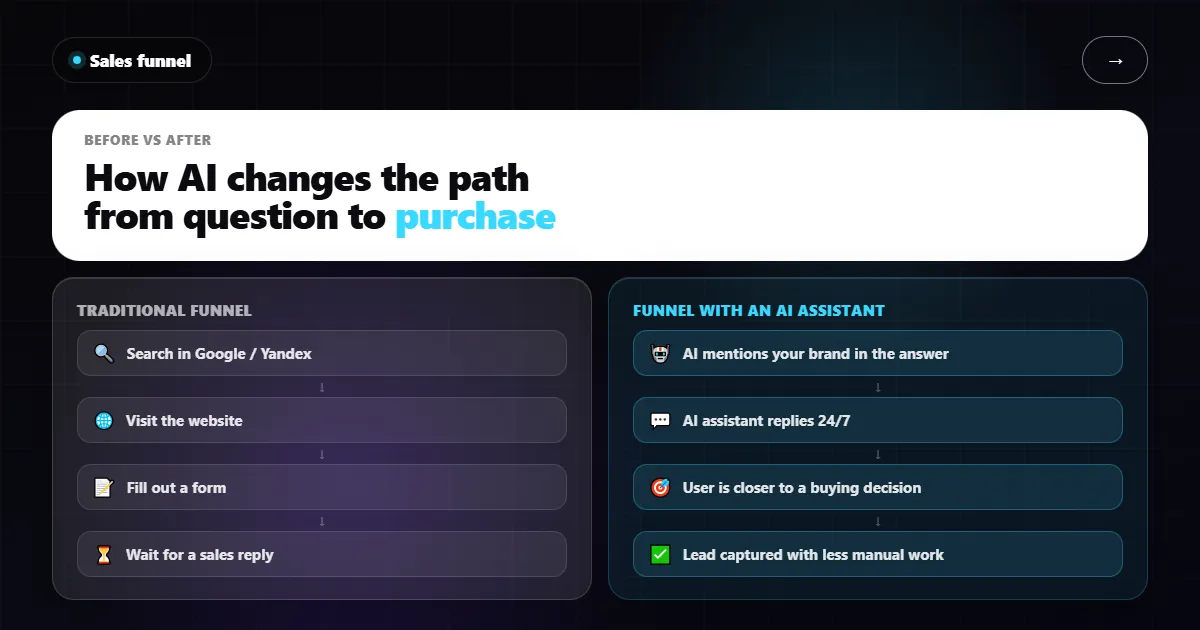
If AI is intercepting users before they reach your site, then part of your response should be to use AI inside your own conversion flow.
That does not mean “replace your team with a chatbot.” That is lazy thinking.
It means using AI where it actually improves throughput:
qualify inbound requests,
answer repetitive questions,
guide visitors to the right offer,
shorten response time,
support users outside working hours,
reduce friction before a demo or contact request.
An AI assistant on a high-intent page can do more than a static CTA. It can help users move from uncertainty to action.
This matters even more when every visit becomes more expensive. If organic traffic is harder to win, every session needs to convert better.
How to Adapt Your SEO Strategy for 2026
Here is the blunt version.
Search is not dead. But the old playbook is weaker.
You should not abandon SEO. You should stop treating it like a self-sufficient acquisition machine.
A stronger 2026 strategy combines four layers:
1. Technical and structural SEO
Crawlability, performance, internal linking, clean page architecture, indexation hygiene.
2. Better content economics
Less filler, more expertise, more proof, tighter intent match.
3. GEO optimization
Content built to be quoted, summarized, and trusted by AI systems.
4. Owned audience and conversion infrastructure
Distribution, email, community, remarketing, and on-site conversion systems that reduce dependence on organic clicks.
If you are still investing in SEO as if it were 2021, you are late. Not dead, but late.
Conclusion
The real problem in 2026 is not that search disappeared. The problem is that clicks are no longer guaranteed, even when visibility exists.
That is why so many teams see the same pattern: rankings look stable, but traffic keeps falling.
The businesses that adapt first will not just “save SEO.” They will build a stronger acquisition system around a new reality: search engines are becoming answer engines, and AI systems are becoming gatekeepers.
The practical response is clear:
create source-worthy content instead of generic SEO pages,
build owned channels outside search,
improve conversion systems so fewer visits still produce results,
treat GEO as an extension of modern SEO, not a separate buzzword.
The question is no longer whether this shift is real. The question is how long you want to keep losing clicks before you change the way you work.
If your rankings are stable but traffic keeps dropping, now is the time to audit your content, SERP exposure, and conversion path. The earlier you adapt, the less demand you lose.
Ready to See Why Your Traffic Is Dropping?
If your rankings look stable but organic traffic keeps slipping, the problem may no longer be SEO in the old sense. AI search, zero-click results, and weaker click-through rates are changing how demand reaches your site.
We’ll review your current situation, identify where traffic is leaking, and show you what to fix first — from content and GEO optimization to conversion bottlenecks inside your funnel.
Book a free consultation and get a practical breakdown of what is happening with your search traffic and what to do next.
Frequently Asked Questions
Why is my website traffic dropping if my rankings are stable?
What is zero-click search?
What is GEO optimization?
Is GEO replacing SEO?
What kind of content performs better in AI search?
Should businesses still invest in SEO in 2026?
How do I adapt my website for AI search?
Want to discuss an AI solution for your business?
We'll be happy to explain how LLM models can help automate your processes
Discuss ProjectOther articles
AI SEO Content Writing: A Step-by-Step Guide
AI SEO content writing: learn how to research, outline, draft, and edit content that ranks and converts. Use these prompts and start faster.

How LLM Models Are Transforming Business Automation in 2024
Exploring practical use cases of GPT-4, Claude, and other LLMs for business process automation. From sales to content generation.
ChatGPT vs Claude: Which Model to Choose for Business?
Comparing the two most popular LLM models across key parameters: quality, speed, cost, and practical use cases.